
Welcoming Rida
Get ready to spot a new set of stripes! We're thrilled to welcome four-year-old female Amur tiger Rida (pronounced REED-ah) to our zoo family. She joins us from the European Association of…
Read MoreAdjusted Hours: With Alberta remaining on daylight time year-round, we will be adjusting our operating hours through winter to account for later sunrise and sunset. Starting on Friday, November 13, through Friday, February 12, we will be open daily from 10 a.m. to 5:30 p.m., with last entry at 4:30 p.m.
Grizzly Bears: Our grizzly bear cubs are currently off-habitat to support their first winter sleep.
The Canadian Food Inspection Agency (CFIA) has confirmed the presence of Highly Pathogenic Avian Influenza (HPAI) within 200 kilometres of the Wilder Institute’s Calgary Zoo.
The health and well-being of the animals in our care remains our top priority. Out of an abundance of caution, we’re proactively implementing the following measures to protect our avian species:
Thank you for your understanding and continued support as we work to keep the animals we love safe.
Due to significant construction activities in and around Imagine Asia, the zoo’s West Gate will remain closed until at least 2028/2029. This necessary step supports the safe movement of visitors while we undertake exciting improvements to animal habitats and visitor experiences.
Bite-Sized
The health and well-being of the animals in our care is one of our top priorities. However, even with access to the best nutrition, exceptional habitats and exemplary medical care, there are occasions when Mother Nature has other plans.
Towards the end of August, two Humboldt penguins in our care sadly died from avian malaria. ‘Bianca’ (11 years old) and her son ‘Rio’ (1 year old) both succumbed to the illness. Avian malaria is a mosquito-borne disease of birds transmitted through bites of infected mosquitos. Although these deaths were unexpected as all of our Humboldt penguins have been on preventive medication every summer for the past decade, the disease is widely known to affect many species of birds and is one of the most significant causes of mortality in penguins, under human care and in the wild, with mortality rates ranging from 50-80%.
Following the sudden loss of Bianca and Rio, the Animal Care, Health & Welfare began testing the entire Humboldt penguin colony for signs of infection. The unfortunate reality is that avian malaria does not always show up in blood work in advance and if found, the treatment is not always successful in penguins. None of our other birds were positive on their bloodwork.
Bianca hatched at SeaWorld San Diego in May 2012. She joined the Wilder Institute’s Calgary Zoo family in September 2013, so she lived most of her life with us in Penguin Plunge. Rio hatched here at the Wilder Institute’s Calgary Zoo in June 2022 and was the offspring of the late Bianca and her mate ‘Chango’ (7 years old).
We are deeply saddened by these unexpected losses. Please keep our Animal Care, Health & Welfare team in your thoughts during this difficult time.
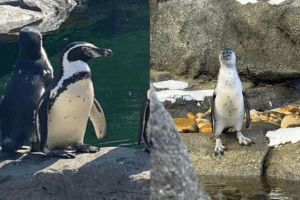
Humboldt penguins, ‘Bianca’ (left) and ‘Rio’ (right)