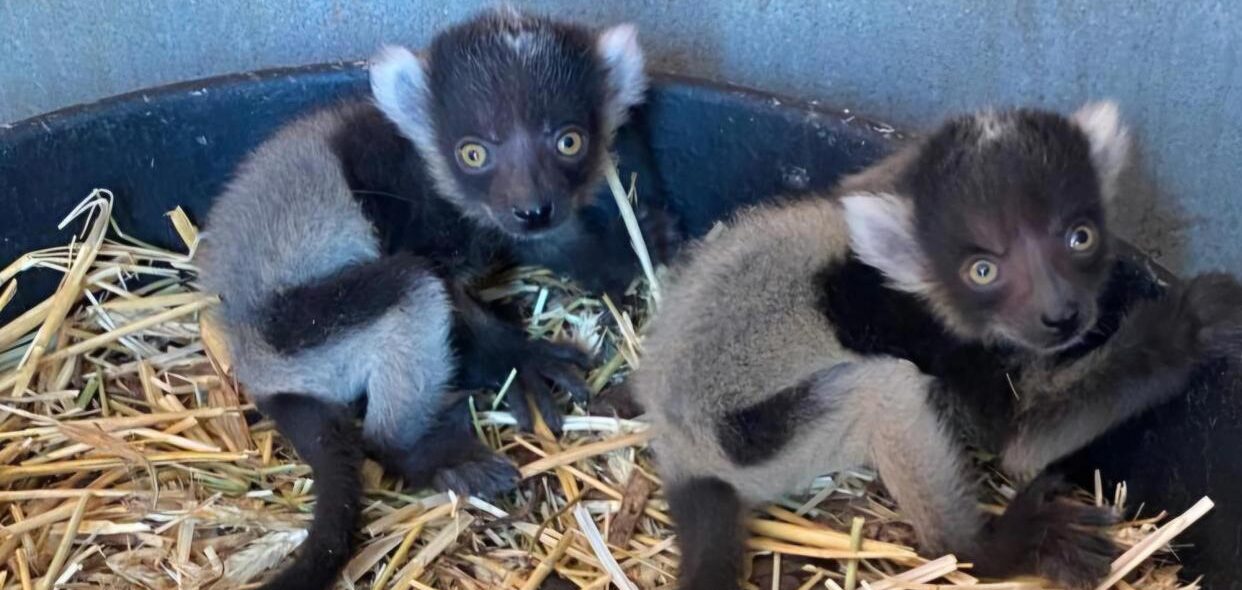
24 APRIL 2025 (Calgary, AB) – There’s triple the reason to celebrate at the Wilder Institute’s Calgary Zoo — three black-and-white ruffed lemur pups, one of the world’s most endangered primate species, were born earlier this month! Five-year-old ‘Eny’ welcomed the trio on April 6, marking her second successful litter with 10-year-old mate ‘Menabe’. Their first successful offspring, two-year-old ‘Sariaka’, made headlines in 2023 as the first black-and-white ruffed lemur born at the zoo since 1987 — and now she’s a big sister!
While the pups have not yet undergone a full health exam or been sexed, the Animal Care, Health & Welfare team are conducting quick visual assessments daily and getting weights as needed.
“It’s still early days, so we’re cautiously optimistic — but all signs are encouraging so far,” said Jennifer Godwin, Animal Care Manager (Asia/Savannah) at the Wilder Institute’s Calgary Zoo. “The pups are bright-eyed, active, and strong. We’re monitoring them closely, but from a distance, to give the family space to bond during these critical first weeks. Eny and Menabe are doing an incredible job — they’re attentive, calm, and clearly know exactly how to care for their little ones.”
Found nowhere else in the world, all lemur species are endemic to Madagascar—including the black-and-white ruffed lemur. This unique primate faces severe threats from habitat loss and hunting. Its population has declined by more than 80% over the past 21 years—a span equivalent to three generations. In the face of such dramatic declines, every successful birth represents a small but vital step toward the species’ survival.
Eny and Menabe were paired through the Species Survival Plan (SSP) — a conservation breeding initiative led by the Association of Zoos and Aquariums (AZA) to ensure healthy, genetically diverse populations in human care, appropriately managing the demographic distribution, and supporting the long-term sustainability of the at-risk species. In 2021, Eny was transferred from an accredited zoo in the Czech Republic to Calgary with the hope that she and Menabe would help strengthen the limited gene pool of black-and-white ruffed lemurs in North America. That hope is now a reality — not just once but four times over.
“Every birth of a black-and-white ruffed lemur is a beacon of hope for this critically endangered species,” added Godwin. “With wild populations facing mounting threats, these pups are a vital lifeline — helping preserve genetic diversity and offering a future for their species. Through collaborative efforts like the Species Survival Plan, we’re not only caring for animals at the zoo — we’re contributing to the survival of species on the brink.”
Eny, Menabe, and their pups are currently bonding behind the scenes and are not yet visible to visitors. In the meantime, Sariaka will be viewable with the rest of the zoo’s conspiracy of black-and-white ruffed, red-fronted, and ring-tailed lemurs in their indoor Land of Lemurs habitat. The popular outdoor Land of Lemurs walkthrough is slated to reopen later this spring.
– 30 –
Additional Information:
- Species Fast Facts:
- Dam (mom): ‘Eny’ (pronounced EN-ee)
- Sire (dad): ‘Menabe’ (pronounced meh-NAH-bay)
- A group of lemurs is called a
- Black-and-white ruffed lemurs are one of the only primate species that build nests for their babies — a rare trait among lemurs and primates alike!
- Lemur pups are born with their eyes open and can start moving around within hours — though they rely on mom and the nest for the first few weeks.
- Lemurs are exceptional pollinators! Their diet includes nectar from large flowers, and as they feed, they help pollinate plants in the same way bees and birds do.
- Black-and-white ruffed lemurs have a powerful call — one of the loudest of all primates — which can travel up to 1 km through the dense Madagascar rainforest!
- Black-and-white ruffed lemurs can leap more than 30 feet in a single bound from tree to tree, using their strong legs and long tails for balance.
For more information contact:
Alison Archambault
Director, Brand & Engagement
403.232.7766 | 403.919.9482 | mediarelations@calgaryzoo.com
For more than 30 years, the internationally accredited Wilder Institute’s Calgary Zoo has been a leading authority in wildlife conservation, reintroducing threatened species to the wild and empowering communities to conserve natural resources to positively impact both the environment and local inhabitants.
While our work is global, our roots run deep in the Albertan conservation community. Sitting on 125 acres in the heart of the city, we operate one of the oldest charities in Alberta, the Wilder Institute’s Calgary Zoo – a not-for-profit charitable wildlife conservation organization that works to fight the extinction of plants and animals worldwide. In addition to the zoo, we proudly operate the Archibald Biodiversity Centre (ABC), Canada’s largest conservation breeding and research facility. Nestled on 330 acres in the Albertan prairies, the ABC is a stronghold for biodiversity and a temporary home to some of Canada’s most iconic species-at-risk.
The Wilder Institute’s Calgary Zoo is passionate about inspiring and educating generations of visitors about the importance of biodiversity and conservation. Together, we will continue to be a force of nature for making the world a wilder place. Learn more at WilderInstitute.org and CalgaryZoo.com.